
UAE Launches First Drone Strike Against al-Shabaab in Somalia Since 2025
· 22 views
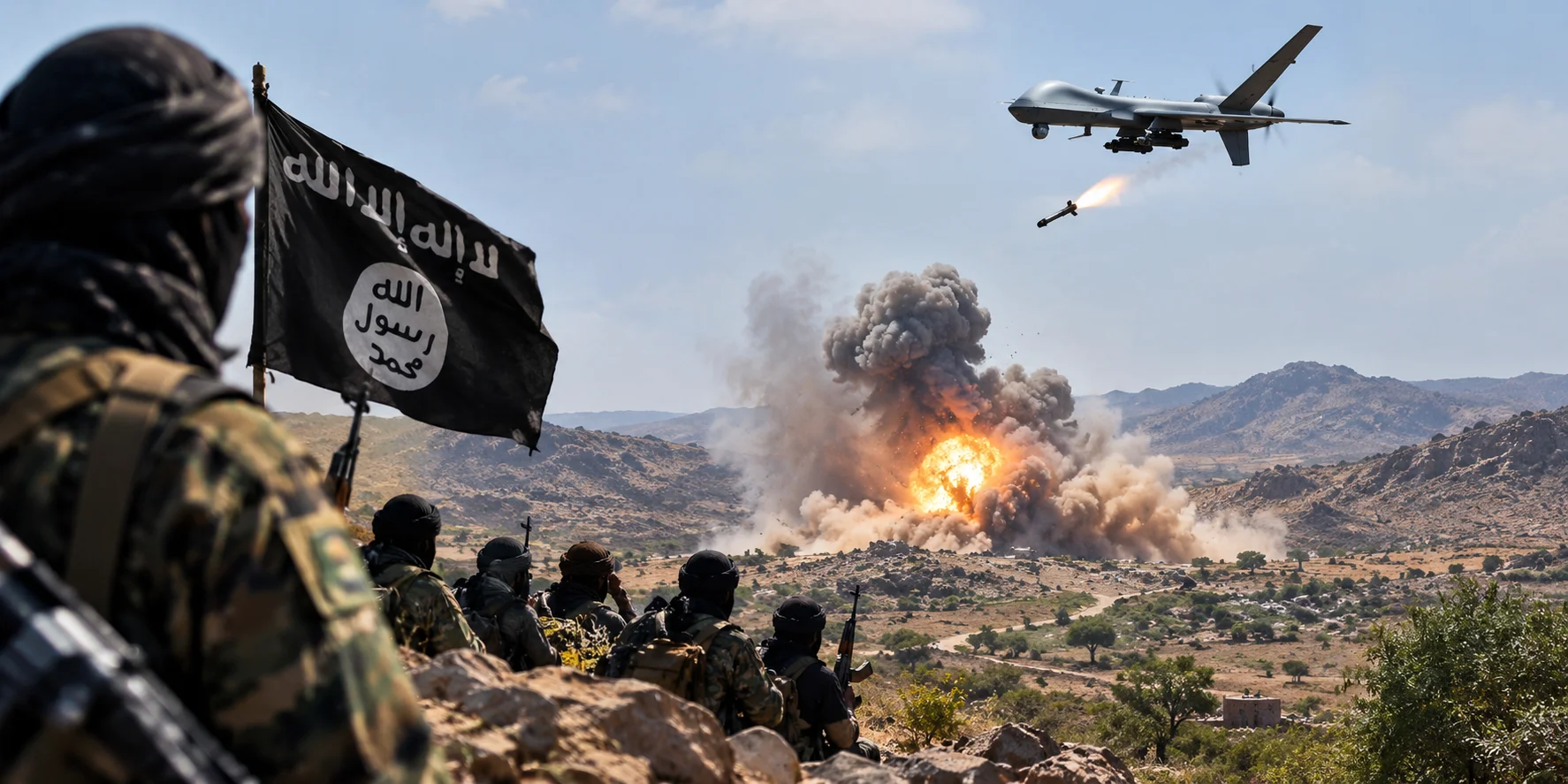
MOGADISHU (Terror Monitor) — The United Arab Emirates has carried out its first reported drone strike against al-Shabaab militants in northern Somalia in nearly a year, targeting fighters belonging to the al-Qaeda-linked militant group in the semi-autonomous Puntland region, security officials told Agence France-Presse (AFP) on Wednesday.
The strike was conducted on Tuesday in the Galgala mountain pass, located in the Al Madow mountain range, where al-Shabaab has maintained a presence for several years, according to security officials cited by AFP.
The attack marks the first reported UAE drone strike in the area since November 2025, highlighting the continued involvement of foreign partners in operations against the militant organisation amid growing political tensions in Somalia.
Somali federal authorities have not publicly commented on the latest strike.
Al-Shabaab Maintains Presence in Puntland Mountains
Somalia has been battling an armed insurgency by al-Shabaab for more than two decades. Despite sustained military operations by Somali forces and their international partners, the group continues to control or operate across significant areas of the country.
Al-Shabaab, which is affiliated with al-Qaeda, has carried out attacks against Somali security forces, government institutions and civilians as part of its campaign to overthrow the internationally recognised federal government and establish its own system of rule based on its interpretation of Islamic law.
Although the group's main strongholds are concentrated in southern and central Somalia, it has also established positions in the mountainous areas of Puntland, particularly in the Al Madow range.
The organisation's presence in northern Somalia is comparatively smaller than its footprint in the south and centre of the country. However, the region's rugged terrain provides opportunities for militants to establish hideouts and complicate military operations.
The Galgala mountain pass has been among the areas where security forces have sought to restrict militant movements and disrupt the group's operational networks.
The UAE's latest reported strike indicates that counterterrorism operations against al-Shabaab remain active in the region, even as Somalia faces mounting political and security challenges.
UAE's Counterterrorism Role in Somalia
The United Arab Emirates is among several foreign countries that have supported efforts to combat al-Shabaab in Somalia.
International involvement has included military assistance, training, logistical support and operations intended to weaken the group's leadership and operational capabilities.
The UAE has maintained security relationships with authorities and regional administrations in Somalia, including Puntland, which has its own security forces and has conducted operations against militant groups in its territory.
However, the UAE's relationship with Somalia's federal government in Mogadishu has become strained, partly because of Abu Dhabi's support for regional political actors opposed to the federal authorities.
These tensions have complicated the broader political environment surrounding security cooperation in the country.
The latest drone strike comes against this backdrop, although security officials cited by AFP did not publicly establish whether the operation was coordinated with Somalia's federal government or provide details about the arrangements under which it was conducted.
The number of militants killed or injured in the strike was not immediately disclosed in the available account.
Somalia Faces Growing Political Tensions
The reported attack comes as Somalia confronts increasing political divisions over governance, relations between the federal government and regional administrations, and plans for national elections scheduled for next year.
Some regional governments have rejected aspects of the federal government's electoral plans, raising concerns about the potential for political disagreements to undermine cooperation on national security.
Somalia's federal system divides authority between the central government and regional administrations, and disputes over constitutional arrangements, electoral procedures and the distribution of political power have repeatedly complicated efforts to establish a unified political framework.
These divisions are particularly significant because the campaign against al-Shabaab requires coordination among federal security forces, regional authorities and international partners.
A deterioration in relations between Mogadishu and regional administrations could complicate intelligence sharing, operational coordination and the allocation of resources for counterterrorism operations.
Although the UAE's latest reported strike was directed against al-Shabaab, the wider political environment could influence how future security operations are conducted and coordinated.
Questions Over Future International Support
Uncertainty is also growing over the future of international logistical assistance for the campaign against al-Shabaab.
The United States has announced plans to end its funding for a key United Nations logistical operation supporting the fight against the militant group at the end of 2026.
The operation plays an important role in supporting international and African-led security efforts in Somalia, including logistical arrangements intended to sustain forces engaged in operations against al-Shabaab.
Any reduction in international financial support could place additional pressure on the forces involved, particularly if alternative funding arrangements are not secured.
Logistical assistance is essential for maintaining military deployments, supplying personnel, transporting equipment and sustaining operations in remote areas where infrastructure is limited.
Somali forces and their international partners have continued to confront al-Shabaab despite years of military campaigns. However, the long-term effectiveness of these efforts depends not only on battlefield operations but also on reliable funding, political cooperation and the ability to maintain security gains.
The reported UAE drone strike therefore comes at a time when questions are being raised about both the political coordination and financial sustainability of the broader counterterrorism campaign.
Regional Security Implications
Al-Shabaab remains one of the principal security threats facing Somalia and the wider Horn of Africa.
The group has repeatedly demonstrated its ability to conduct attacks against military installations, government targets and civilian locations. It has also carried out operations beyond Somalia's borders, particularly in neighbouring Kenya.
Its continued presence in Puntland presents a separate challenge because the region's mountainous terrain and distance from Somalia's principal population centres can complicate surveillance and military operations.
For the UAE, counterterrorism engagement in northern Somalia forms part of its broader regional security involvement. However, strained relations with Mogadishu could complicate the diplomatic environment surrounding future operations.
For Somalia, the challenge is to sustain pressure on al-Shabaab while managing political disagreements and maintaining international support for its security institutions.
The latest reported strike underscores the continued role of foreign partners in efforts to weaken the militant group. Nevertheless, the broader campaign faces several unresolved challenges, including political divisions, questions over international funding and the difficulty of preventing al-Shabaab from rebuilding its operational networks.
As of Wednesday, Somali federal authorities had not issued an official statement on the reported UAE strike, and details regarding casualties and the operation's immediate results remained unclear.
Related Articles
Pakistan Reports 1,100 Terrorists Killed in Over 50,000 Security Operations in Balochistan This Year
Pakistani authorities say security forces have conducted more than 50,000 operations in Balochistan this year, killing approximately 1,100 terrorists. Officials also reported 315 security personnel and 551 civilians killed. Meanwhile, authorities have ordered around 30,000 residents of Shorparod to evacuate by October 30 ahead of planned operations against terrorist hideouts.

Pakistan: Six Bullet-Riddled Bodies Recovered in Balochistan’s Gwadar and Washuk
Police recovered six bodies bearing gunshot wounds from Gwadar and Washuk districts in Pakistan’s Balochistan province. Four bodies were found in Pasni and two in Washuk. The discoveries follow the recovery of 12 bodies from Dera Bugti, Barkhan and Panjgur on October 13. Police said the motives behind the separate killings remain unknown.
Pakistan: Six TTP Militants, Including Key Commander, Killed in Joint Operation in Peshawar
Pakistani security forces and police killed six TTP militants, including a key commander, during a joint operation in Mattani on the outskirts of Peshawar, Khyber Pakhtunkhwa, on Monday.

Pakistan Army Major Killed in BLA-Claimed Attack in Balochistan; Four Militants Killed
A Pakistan Army major was killed in a BLA-claimed IED attack in Balochistan’s Gwadar district, while security forces killed four suspected militants during a separate intelligence-based operation in Kalat. The military said clearance operations were continuing to eliminate remaining militant threats.