
Pakistan Initiates Mediation Process Between Rival Factions in Libya
· 79 views
ISLAMABAD (Terror Monitor) — Pakistan has launched a mediation effort between Libya’s rival eastern and western power centers as part of a quiet diplomatic initiative aimed at resolving the country’s long-running political crisis, according to Pakistani sources cited by Reuters.
The development comes as the United States has been leading diplomatic efforts for several months to find a political solution to Libya’s divisions.
Two Pakistani sources told Reuters that Pakistan had also played an important role in facilitating talks between the United States and Iran earlier this year, an effort that was publicly appreciated by the U.S. administration on several occasions. One source said Washington was “fully aware of and involved in” Pakistan’s diplomatic efforts regarding Libya.
The sources said the initiative has also received support from Saudi Arabia, which has sought to maintain influence in Libya for years.
According to the sources, reconciliation efforts began late last year after both Libyan factions approached Pakistan and requested it to play a mediating role.
Pakistan’s Foreign Ministry, the Inter-Services Public Relations (ISPR), Libya’s eastern and western administrations, as well as Qatar, Turkey, Saudi Arabia, and the U.S. State Department did not immediately comment on the report.
Analysts say any successful plan to reunify Libya would require balancing the competing interests of foreign powers, resolving disputes over government positions, election rules, and oil revenues — issues that have repeatedly contributed to the failure of previous reconciliation efforts.
Jalel Harchaoui, a Libya analyst at the UK-based Royal United Services Institute (RUSI), said the United States was making a strong push for a diplomatic solution in Libya, but the proposed framework remained unclear and incomplete.
According to a “Libya Reunification Plan” reviewed by Reuters, the proposal includes a 36-month transitional power-sharing arrangement under which new institutions, including a “Government of National Consensus” and a “Presidential Council,” would be established.
Sources said that while details of the plan are still under discussion, the proposed arrangement would allow Abdul Hamid Dbeibeh, prime minister of the UN-recognized western-based Government of National Unity, to remain in office. Meanwhile, Saddam Haftar, deputy commander of the eastern Libyan National Army (LNA), would reportedly be appointed chairman of the Presidential Council.
The proposed plan also includes granting LNA commander Khalifa Haftar authority over the national budget. The eastern-based faction led by Haftar currently controls large parts of Libya’s oil reserves and key energy facilities.
A Pakistani source said Islamabad would play an active role in maintaining the proposed political arrangement and ensuring its implementation, although final details are still being negotiated.
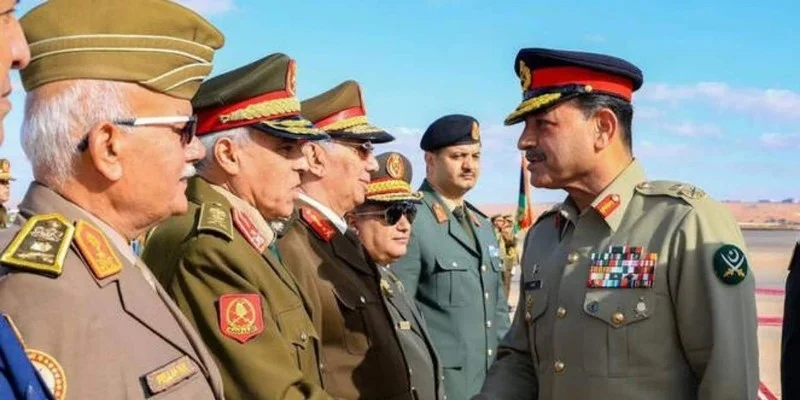
As part of the reconciliation efforts, Pakistan’s Chief of Army Staff Field Marshal Asim Munir met Saddam Haftar in Rawalpindi last month. Days later, Saddam Haftar visited Washington, where he also met U.S. Secretary of State Marco Rubio.
Analysts say that although Pakistan’s influence in Libya remains relatively limited compared with the United States, the United Arab Emirates, Egypt, and Turkey, Islamabad’s relations with both rival Libyan factions provide it with a unique diplomatic position.
Reuters reported that Pakistani officials have continued to develop defense cooperation with the LNA, including discussions over the possible sale of JF-17 fighter jets and Super Mushshaq trainer aircraft despite a UN arms embargo.
A document reviewed by Reuters indicated that Libya’s UN-recognized Government of National Unity in the west has also recently expressed interest in holding direct talks with Pakistan.
Sources said Qatar and Turkey, key supporters of the Government of National Unity, encouraged Pakistan’s involvement in the mediation process.
However, Tarek Megerisi, director at geopolitical consultancy firm Informa, warned that even if an agreement is reached, there is no guarantee it would be implemented. He cited the example of a deal signed last year between the leaders of Rwanda and the Democratic Republic of Congo, which collapsed within months.
Related Articles
Russia Says Overnight Strikes Hit Ukraine’s Largest Steel Plant, Power Infrastructure and Cargo Ship
Russia said its forces struck Ukraine’s largest steel plant in Kryvyi Rih, power infrastructure and another steelworks overnight, along with a cargo vessel in the Black Sea allegedly carrying military supplies. Separately, a Ukrainian drone attack in Russia’s Belgorod region killed a woman and wounded a man, according to TASS.
Myanmar Military Airstrike Kills 11 Civilians, Including Women and Children, in Rebel-Held Village
At least 11 people, including six women and two children, were killed in a Myanmar military airstrike in Yesagyo Township, southwest of Mandalay, according to a resistance fighter. The attack destroyed three houses as Myanmar’s civil war continues following the 2021 military coup.
Saudi Arabia Intercepts Four Drones Over Riyadh and Other Regions as Egypt Offers to Defend Kingdom
Saudi Arabia said it intercepted and destroyed four drones over Riyadh, the Eastern Province and southern regions on Saturday amid continuing attacks attributed to Iran-backed Houthi rebels. Egyptian President Abdel Fattah al-Sisi said Cairo was ready to defend Saudi Arabia if requested, subject to parliamentary approval.
Germany Warns Europe Is in Iran’s Crosshairs, Vows to Counter Tehran’s Hostile Activities
German Foreign Minister Johann Wadephul warned that Europe is in Iran’s crosshairs following a court ruling that sentenced two men for plotting attacks against Jewish and pro-Israel figures on behalf of Iranian intelligence. He also warned of growing Russian threats and urged the European Union to maintain sanctions against Moscow.